Operations 13 min read
RV Rental Delivery and Setup: How to Run It and What to Charge
How trailer rental fleets run delivery and setup at campsites: what setup includes, what delivery costs, how to price it, scheduling and insurance.

On this page
- Why deliver at all
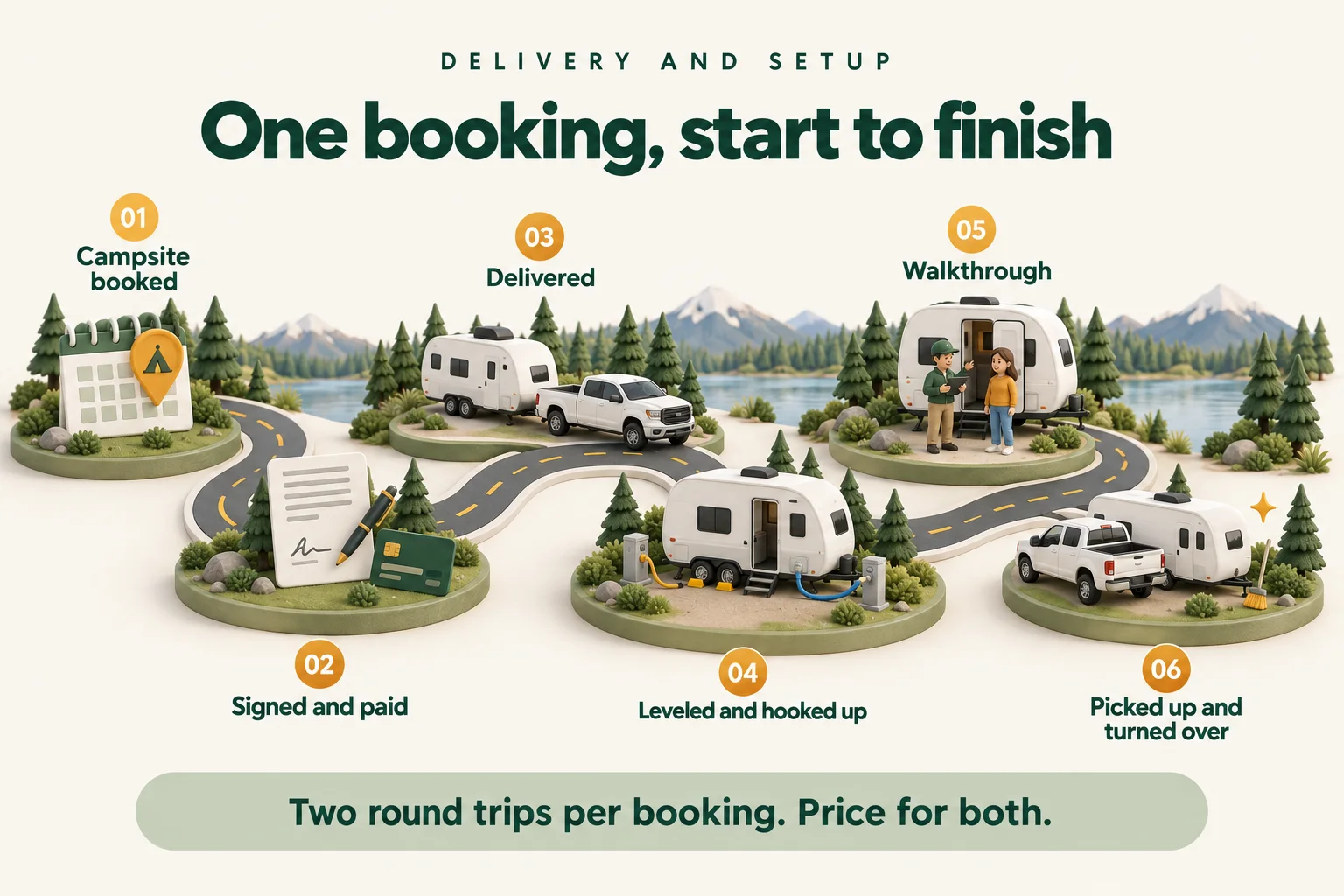
- How a delivered rental runs, start to finish
- What setup includes
- What delivery really costs you
- What to charge for delivery
- Scheduling: trucks, windows and turnover
- Campgrounds: rules, seasons and service areas
- Insurance: the drive is the gap
- Tell renters what to expect
- Running delivery bookings in BookCollie
- Sources
RV rental delivery and setup means you tow the trailer to the renter's campsite, level it, hook it up, show them how it works and come back for it at the end of the trip. The renter never needs a truck or a hitch. For a trailer rental business it's the biggest reason renters choose you, and the biggest cost you'll carry on every booking.
This guide is for owners who deliver, or are thinking about it. It walks through how a delivered rental runs from booking to turnover, what setup includes, what delivery really costs you, three ways to charge for it, how to schedule trucks, and what to sort out with campgrounds and your insurance agent. The examples come from Luv2Camp, a family business that has delivered travel trailers to campsites around San Diego since 2003 and runs its bookings on BookCollie, and from fleets that publish their delivery prices.
Our take, from building booking software around delivery fleets: every delivered booking is two round trips, and almost every pricing mistake comes from forgetting the second one. Price both, and the rest of this guide gets easier.
Why deliver at all
Most people who'd love a weekend in a travel trailer don't own a truck that can tow one. Delivery opens your fleet to all of them: families trying RV camping for the first time, people flying in, groups at a festival, and campers who simply don't want to back a 30-foot trailer into a tight site. RVshare's advice to new owners says the same: delivery within your area draws in renters who are new to RVs or uncomfortable driving a rig.
It also protects your trailers. When your driver tows, hitches and levels every time, you aren't relying on a stranger's tow vehicle, brake controller or reversing skills. Luv2Camp lets renters tow only in one desert service area; everywhere else, its drivers do every move.
The trade-off is that you're now running a small logistics company as well as a rental business. You need trucks, drivers, a delivery schedule and prices that cover the miles. The rest of this guide is about doing that well.
How a delivered rental runs, start to finish
Here's the sequence most delivery fleets follow, with Luv2Camp's published policies as the example.
- The renter books the campsite first. Campgrounds take reservations in the camper's name, so the renter reserves the site and tells you the campground and site number. Luv2Camp doesn't book campsites for renters, and advises booking early for peak dates and holidays. Check the site's length limit against your trailer before you confirm.
- They reserve the trailer and sign. Luv2Camp takes a non-refundable reservation fee ($100 off-peak, $200 for peak, holidays and events) that counts toward the total, and the contract must be signed within 72 hours or the booking cancels.
- Payments come in on a schedule. Half the balance 30 days before arrival, the rest a week before, and everything up front for last-minute trips. A $500 security deposit stays on the card on file.
- You deliver in a window, not at a time. Luv2Camp delivers to RV parks between 1 and 5 pm and texts a one-hour window the morning of arrival. The renter doesn't have to be there for the drop-off itself.
- You set it up. Level it, chock it, unhitch, lower the stabilizers, connect power, water and sewer, put the slide and awning out (see the next section).
- You walk them through it. The driver shows the renter how everything works and answers questions. This is the one part they need to be there for.
- They camp; the trailer stays put. A delivered trailer can't move once it's set up. Say so in the agreement.
- You collect it at checkout. Luv2Camp's checkout is 10 am sharp. The renter can leave before the driver arrives, as long as they've swept, done the dishes and taken the trash out. Tanks don't need dumping, and they don't refill the water.
- You turn it over. Back at the yard: dump the tanks, clean, restock, fix what's broken, fill the fresh water and photograph it for the next renter.
The cleaning rule is a neat trade: renters do the light cleaning (Luv2Camp is clear that dishes aren't re-washed before the next rental), and in return they never touch the sewer hose. Renters like it, and your crew gets the trailer back in a known state.
What setup includes
"Delivered and set up" should mean the renter walks in and the trailer works. Write down what your drivers do so every setup is the same, and so renters know what they're paying for.
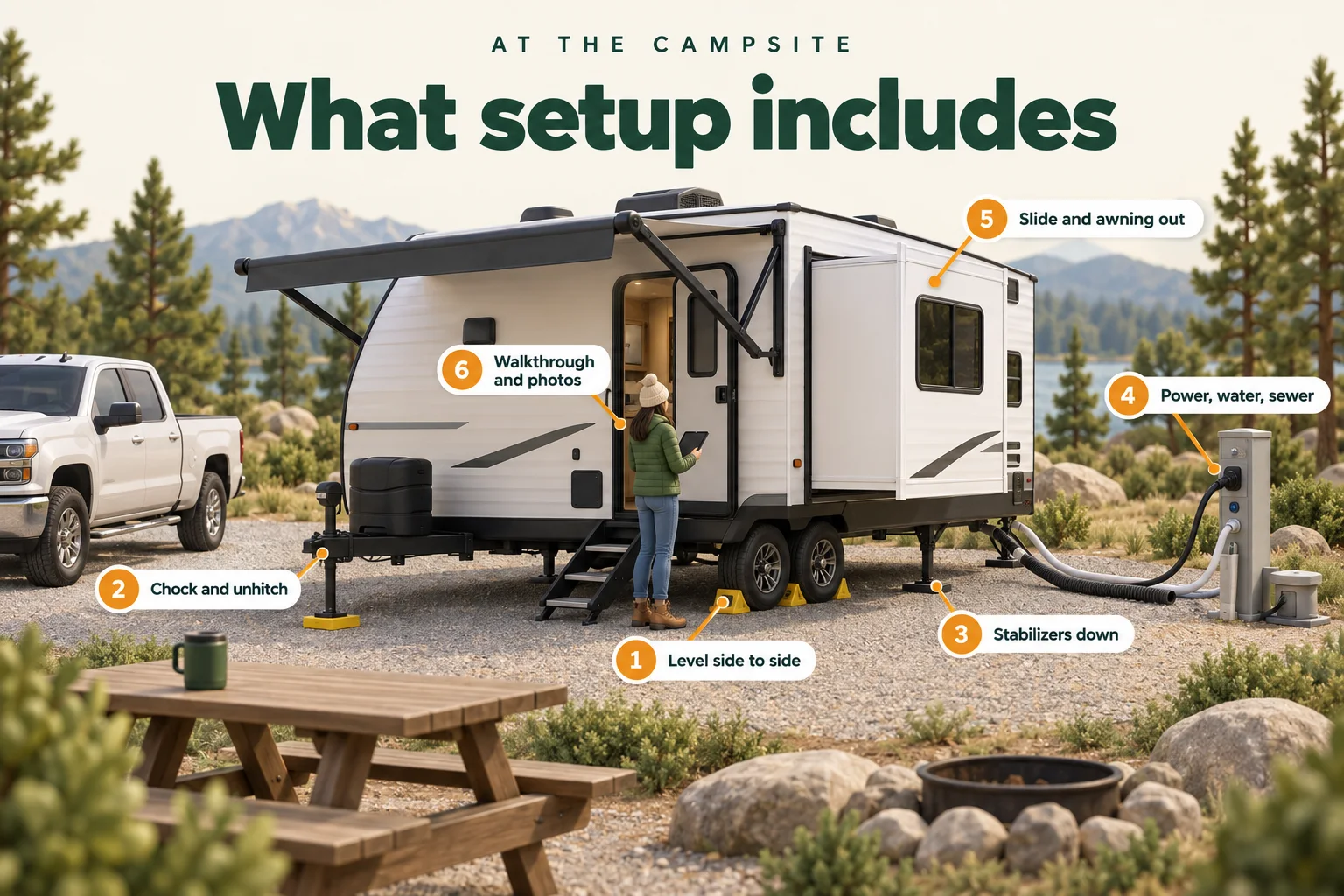
A full setup at the campsite:
- Level it side to side on leveling blocks, then front to back with the tongue jack. A fridge that isn't level won't cool properly.
- Chock the wheels and unhitch. Chocks go on before the coupler comes off.
- Lower the stabilizers. They stop the rocking; they don't hold the weight. That's what the tires and tongue jack are for.
- Connect power, water and sewer to the site's pedestal, with a pressure regulator on the water and a surge protector on the power if you use them.
- Put the slide and awning out, and turn on the fridge, water heater and air conditioning so the trailer is cool by the time they arrive.
- Walk the renter through it and take photos. Show them the thermostat, the water pump, the awning, the generator if they rented one, and what to do if something stops working. Take dated photos of the outside and inside before you leave. They're your evidence if there's a damage question at pickup.
El Monte RV's published setup service lists the same core: black tank hose, fresh water hose, shore power, leveling (on sites with a slope of 3 degrees or less) and switching on the major appliances.
Two things renters always ask about that you should answer in writing: power (what runs on a 30 amp site, and what doesn't run on a generator; Luv2Camp's generators can't run the air conditioner) and dry camping (how long the fresh water and batteries last with no hookups). Our rent-ready checklist for travel trailers covers what to stock and check before each trip.
What delivery really costs you
Here's where owners lose money. A delivered booking is four trips: tow it there, drive back empty, drive out empty to collect it, tow it back. The trips cost the same whether the renter stays two nights or ten.
One delivered booking, four trips
A campground 30 miles away is 120 miles of driving, two of them towing
In the example, a campground 30 miles from the yard costs about $206 per booking: around $44 in fuel, $36 in truck wear and $126 in driver time. On a two-night booking at $469 that's 44% of the price. On a seven-night booking at $1,144 it's 18%.
That explains two things you'll see on almost every delivery fleet's rate sheet:
- Minimum stays. A two-night minimum (three for peak dates, holidays and events) stops a one-night trip from costing more to deliver than it earns.
- Short stays cost more per night. Luv2Camp's 26 ft trailer is $469 for two winter nights (about $235 a night) and $1,144 for seven (about $163 a night). The delivery cost is spread over more nights.
Work out your own number before you set prices. You need four things: your truck's fuel use towing and empty, your fuel price, what a driver costs you per hour, and how long setup and pack-up really take your crew. Time a few deliveries. Owners almost always guess setup too short.
What to charge for delivery
There are three common ways to charge, and many fleets combine them.
Three ways to charge for delivery
With what real fleets publish
Included in the price
Delivery and setup are part of the nightly total inside each service area.
- Good: One price, so renters book fast
- Watch: Short stays and far sites eat the margin
Luv2Camp
- 26 ft trailer, 2 winter nights
- $469
- A few farther campgrounds
- +$120–$150
Base fee plus miles
A round-trip fee for nearby sites, then a rate for each mile beyond.
- Good: Far sites pay their own way
- Watch: More lines at checkout to explain
El Monte RV
- 30-mile round trip
- $150
- Each mile over 30
- $5
- Full setup
- $175
A discount to tow it yourself
Renters with a tow vehicle collect it and pay less.
- Good: Frees a truck on busy days
- Watch: Hitch checks and more insurance questions
Luv2Camp, Ocotillo Wells
- Self-haul
- 10% off
1. Include it in the price. Luv2Camp quotes one total with delivery and setup included anywhere in a service area, and adds a fee only for a few farther or harder campgrounds: $120 for Crystal Cove State Park and $150 for Bolsa Chica, for example. Renters see one number and book faster. The risk is that short stays and far campgrounds quietly lose money, so check the worked example above against your own rates.
2. Base fee plus miles. El Monte RV charges $150 for a round trip of up to 30 miles, $5 a mile beyond that, $50 an hour if drop-off or pickup takes longer than 30 minutes, and $175 for a full setup. It's fair for far sites, and it's easy to defend because it follows your real costs. The downside is more lines at checkout.
3. A discount to tow it yourself. Luv2Camp takes 10% off in Ocotillo Wells for renters who tow it themselves. A self-haul option frees a truck on your busiest days, but you'll need to check every renter's tow vehicle and talk to your insurance agent first.
A few pricing details that save arguments later:
- Charge per campground, not per address, until you've delivered there. A named list of campgrounds with their fees and minimums is easy for renters and lets you add a fee for the site with the bad access road.
- Plan for fuel prices. Luv2Camp adds a fuel surcharge to the final payment when gas goes over $5 a gallon: $20 for every dollar above it. It's one line in the agreement and it protects every booking taken months ahead.
- Price events separately. Festivals and races often need delivery on a set day and pickup on another (San Diego's Bayfair is Thursday to Monday at Luv2Camp, with a 4-night minimum). Make them their own campground with their own minimum.
For the rest of your rate sheet (seasons, length of stay, deposits and fees), see how much to charge for RV rental.
Scheduling: trucks, windows and turnover
Your trucks, not your trailers, are usually what limits how many bookings you can take on a Friday.
One truck's Friday
A pickup in the morning, two deliveries in the afternoon window
One truck tows one trailer at a time, so each delivery is a round trip from the yard. With campgrounds about 30 miles out, a morning pickup and two afternoon deliveries fill a driver's day. Ten trailers going out on the same Friday need several trucks and drivers, or some of those deliveries moved to Thursday.
What helps:
- Deliver in a window, and give the exact hour on the day. "Between 1 and 5 pm, and we'll text you a one-hour window that morning" lets you plan the route once you know the day's pickups.
- Collect at checkout time, and say it's firm. Luv2Camp's 10 am is "no exceptions" because the afternoon deliveries depend on it. KORV arrives about an hour before the campground's checkout time.
- Keep turnover time between bookings. A trailer collected at 10 am can't be delivered to the next renter at 1 pm unless your yard crew can dump, clean and restock it in between. Block that time on the calendar so it can't be booked.
- Confirm the times twice: when they book, and again a day or two before the trip, with the campground and site number.
- Use minimum notice. A few days' notice (KORV asks for three) gives you time to plan the truck and check the campsite.
- Watch your delivery days, not just your trailers. When Fridays fill up, raise Friday prices, offer Thursday delivery or set a longer minimum for weekends that start on Friday.
Campgrounds: rules, seasons and service areas
Every campground you deliver to has its own rules, and they range from "anyone can deliver" to "nobody can", sometimes within the same park system. Check before you take the booking. A few real examples:
- Yellowstone: at Mammoth Campground, delivering or collecting rental RVs and campers from outside the park is prohibited.
- Zion: delivery needs a Commercial Use Authorization. It's allowed only to reserved electric sites in two loops of Watchman Campground, no earlier than noon on arrival day, and the renter must make the campsite reservation; rental companies can't book sites for them.
- Buffalo National River: a Commercial Use Authorization for delivering rental RVs to reserved sites. You send the park the delivery details before each drop-off, and one renter can stay at most 14 nights in a row.
- Disney's Fort Wilderness: only Disney's Featured Providers, a short list of rental companies that includes KORV, can deliver and set up rental RVs.
- California State Parks: Luv2Camp delivers under a contract for the San Diego Coast District.
Then, for every campground you serve:
- Know what they need from you. Some want the delivery driver's name ahead of time; Zion asks for the reservation number at the campground kiosk. Keep it in that campground's notes so every driver knows.
- Check the exact site before you go. Look it up on the campground's map, or ask the campground host, so you don't level a trailer on the wrong site.
- Site length and access. Keep a note for each campground: the longest trailer that fits, low branches, tight turns, soft sand. That's where your extra fees and "26 ft only" rules come from.
- Campground minimums. Some campgrounds need a longer minimum on busy dates, like Crystal Cove's 4-night minimum on holidays and in summer. Add it to that campground so renters see it before they book.
- Open desert and unmarked sites. For dry camping with no site number, someone has to meet the driver to choose the spot. Luv2Camp delivers to Ocotillo Wells' open desert from 10 am and asks renters to coordinate the spot.
- Homes and events. Delivering to a driveway? Check the HOA's parking rules and whether the house's power and water suit your trailer. For festivals, races and tailgates, confirm with the organizer that outside companies can deliver and set up. Events that come back every year get easier each time.
Seasons matter too. If you serve more than one area, each can open and close on its own calendar:
Service areas open when camping is good there
Four areas, four seasons, one fleet
Luv2Camp's Temecula area closes from mid-June through September because inland summers are too hot to camp, while Ocotillo Wells is a winter desert season, from mid-October to mid-March. Close an area on your booking site when it's closed, rather than taking bookings you'll have to talk renters out of.
Insurance: the drive is the gap
Delivery adds two stretches most rental insurance doesn't think about: the drive to the campsite and back, and the setup work at the site.
- The drive. Towing your rental trailer to a customer is business use of your truck. Personal auto policies commonly exclude it, and marketplace protection plans cover the renter's trip, not your delivery. Ask about commercial auto for the truck and cover for the trailer while it's being towed.
- The trailer at the site. Make sure your policy covers the trailer while it's parked at a campground you don't control, for the whole booking.
- The setup work. A renter who trips over a leveling block, or a sewer hose that leaks onto the next site, is a general liability question.
- Damage between you and the renter. Take a security deposit (Luv2Camp keeps $500 on the card on file), get the agreement signed before delivery, and take dated photos at drop-off and pickup.
This is general information, not insurance or legal advice. Coverage depends on your state, your policy wording and how you rent. Talk to a licensed agent who writes rental fleet policies.
Our guide to RV rental insurance for owners compares eight ways to cover your trailers, including what marketplace plans leave out during delivery. The rental agreement checklist covers the clauses delivery needs: no moving the trailer, cleaning, fuel surcharges and damage.
Tell renters what to expect
Most "how does this work?" calls are the same ten questions. Put the answers on your website and in the confirmation email:
- That they book the campsite, and that you need the campground and site number.
- The delivery window and how you'll confirm the hour.
- Whether they need to be there (for the walkthrough, yes).
- Checkout time, and what "leave it tidy" means.
- What runs on the site's power, and what a generator can and can't run.
- That the trailer can't be moved once it's set up.
- What's in the trailer and what to bring (Luv2Camp suggests paper plates to save water when dry camping).
- How deposits and payments work, and what happens if they cancel.
Running delivery bookings in BookCollie
BookCollie is built around fleets that deliver. Each location is a service area with its own rates, seasons and closures. Under it, each campground has its own delivery fee, minimum stay and notes. Renters choose a campground on your booking site and see one total with delivery included, and the site won't offer a closed area or a trailer the campground can't take. Delivery windows and collection times can be set per location, or per campground and date with a rule. Self-haul can be its own option with its own discount, and on the Fleet plan you can price delivery by address for places not on your list.
Every booking keeps the signed agreement, the deposit on the card and the check-out and check-in photos together. The calendar blocks turnover time, so a trailer collected at 10 can't be booked out again at 1 unless you say so. Luv2Camp moved its 20 years of bookings over from Salesforce and runs all four of its service areas this way.
See the trailer rental software, or start a free trial and set up your first service area in an afternoon.
Sources
Checked November 4, 2026.
- Luv2Camp, How it works, Frequently asked questions and Locations and pricing.
- El Monte RV, RV delivery.
- KORV (Kissimmee Orlando RV Rental), FAQ.
- RVshare, How to start your own RV rental business and Best practices for RV delivery.
- Recreation.gov, Mammoth Campground (Yellowstone).
- National Park Service, Zion, 2026 operating plan for commercial camper trailer and RV delivery; Buffalo National River, RV delivery and setup.
- planDisney, Companies authorized to deliver campers to Fort Wilderness (September 16, 2025).
- Fuel use, truck wear, driver pay and drive times in the worked example are illustrative assumptions, shown with the graphic. Use your own.
Frequently asked questions
How much should I charge for RV delivery and setup?
Enough to cover two round trips, because every delivered booking needs one to drop the trailer off and another to collect it. For a campground 30 miles away that's 120 miles and about four and a half hours of a driver's time, which in our worked example costs about $206. Published prices range from delivery included in the nightly rate (Luv2Camp) to $150 for a 30-mile round trip plus $5 a mile beyond and $175 for full setup (El Monte RV).
Does the renter need to be at the campsite for delivery?
Usually not. Luv2Camp and KORV both deliver without the renter there. But the walkthrough needs them, so ask them to be there for it, and for open desert or unmarked sites someone has to be there to choose the exact spot.
Who books the campsite when you deliver a rental trailer?
Almost always the renter. Delivery fleets ask renters to reserve their own site first and give you the campground and site number, because campgrounds take reservations in the camper's name. Check that the site is long enough for the trailer before you confirm the booking.
Can renters move a delivered trailer?
Not if they don't have the truck, and most delivery fleets say so in their terms: once it's set up, it stays. If you allow self-haul, set it up as its own option with a tow vehicle check, rather than letting renters move a delivered trailer.
Do I need commercial insurance to deliver rental trailers?
Talk to an agent, but plan on it. Towing your rental trailer to a customer is business use of your truck, which personal auto policies commonly exclude, and marketplace protection plans only cover the trip itself. Ask about commercial auto for the truck, cover for the trailer while it's on the road and at the site, and general liability for the setup work.
Can you deliver a rental RV to a national park campground?
It depends on the park. Yellowstone's Mammoth Campground prohibits delivering rental RVs from outside the park. Zion and Buffalo National River allow it only for companies with a Commercial Use Authorization, to sites the renter has reserved, with conditions such as Zion's no-earlier-than-noon delivery. Check each park's commercial services office before you offer it.
How many deliveries can one truck do in a day?
Fewer than most owners expect. One truck tows one trailer at a time, so each delivery means a round trip from the yard. With campgrounds about 30 miles out, a 10 am checkout and a 1–5 pm delivery window, one pickup and two deliveries fill the day.

